Ben Grumbles Nov 4, 2026
★★★★★ Less than 24 hours call to service. Team was prompt and professional! I sincerely appreciate the communication after hours. Nice to know there is a great business handling this type of work when needed.
North Salem is about nine miles northwest of Danville. This page is about the call we get most often from properties that have changed hands a few times: nobody knows where the tank is.
It is more common than people expect and it is not a problem. It is a job with a first step, and the first step is finding it.
Grass grows. Lids get buried when a yard is re-graded or topsoil is added. Paperwork goes missing at a sale, and the next owner has no reason to look for something that is working.
Then it needs service, and the last person who knew where it was moved away in 1998.
Once it is found it is worth marking, and worth a riser if the lids are deep. Both mean this is the last time anybody has to look.
Once a tank has been found, ten minutes of work means nobody repeats the search. A marker at each lid, a photograph with something fixed in the frame, and a note of the distance from a corner of the house is enough.
If the lids sit well below grade, a riser does the same job permanently and turns every future service into a visit that starts with lifting a cap rather than finding a shovel.
Closest first:
The most useful septic paperwork a house can have is a short list nobody thinks to start: every pump-out, written down. It can be a few lines on an index card taped inside the utility closet, or a note on your phone. Each entry needs only a handful of details, and none of them take long to jot down.
After three or four entries, the right interval for your house stops being a guess. You can see how fast the tank fills with your household in it, and whether anything the driver flagged last time has gotten worse.
The list pays off again if you sell. A buyer who is handed a dated record of pump-outs has one less unknown to worry about. When we pump, ask the driver for the gallons and anything worth noting, and add it to the card. Pumping starts at $410.
Tree roots go where the water is, and a septic system offers a steady supply. A hairline gap is enough to let one in. Once inside, a root has a constant supply of water and nutrients, and it keeps growing until it fills a pipe or wraps itself around whatever is in the way.
Roots tend to get in at a few predictable points along the system, starting at the house.
The symptoms build slowly: drains that slow down and then recover, a gurgle after heavy use, a backup that clears and comes back a few months later. Cutting the roots out buys time. Resealing or replacing the joint they came through, and deciding what to do about the tree, is what keeps them from returning.
Some problems cannot be judged from the tank lid. If the tank sits at a normal level and the house still drains slowly, or if a backup keeps returning after a pump-out, the trouble is likely in a pipe, and a pipe has to be seen from the inside.
A video inspection sends a camera down the line, from the house toward the tank or from the tank toward the field. It starts at $425, and it shows what no amount of guessing from the yard can.
That last point is worth dwelling on. Knowing the distance to a problem can turn a repair from trenching a long stretch of yard into opening the ground in one spot. If you are weighing a repair estimate for a line nobody has looked inside, the camera is a sensible step first.
Gravity does most of the work in a septic system. Waste runs downhill from the house to the tank, and from the tank out to the field. A basement bathroom, a laundry room below grade, or a home that sits lower than its tank breaks that arrangement.
In those cases the waste first drops into a sealed basin with a pump inside, often called a sewage ejector or a residential lift station. When the basin fills, a float starts the pump and it pushes the waste up to the main line or the tank. If your house has one, a few simple habits keep it working the way it was meant to.
When this kind of pump stops, the basement fixtures are where it shows first, often as water rising in a floor drain or shower. Call before using more water downstairs.
Large interceptors and commercial tanks raise a practical question before anyone talks about price: will one truck hold it?
Our vacuum trucks carry 2,500 and 3,800 gallons. A big grease interceptor or a commercial septic tank can hold more than either one alone. In that situation both trucks can be sent together so the job is finished in a single visit rather than split across two.
To size the visit correctly, have these ready when you call, if you can.
Knowing the volume in advance means the right capacity shows up the first time, and your kitchen or building is back to normal sooner.
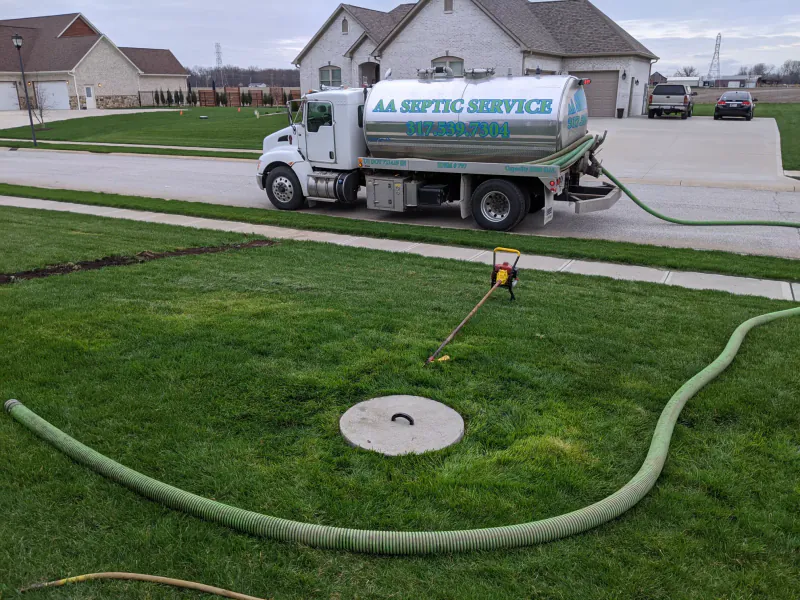
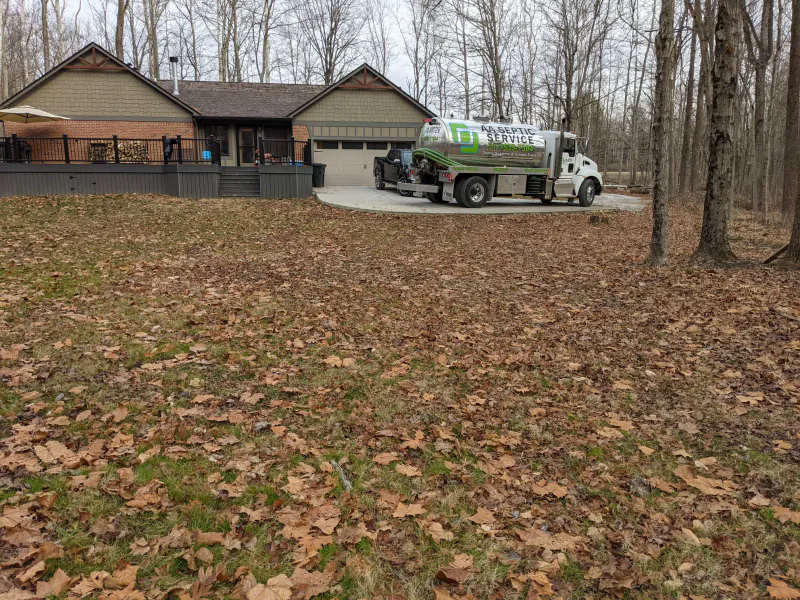
A septic truck cannot always park next to the tank. Tanks sit behind houses, past fences, under decks and at the end of long lanes, and a loaded truck has to stay on ground that will carry its weight.
That is where hose length counts. We carry 200 feet of vacuum hose, so the truck can stay on the drive or the road while the hose crosses the yard. Heavy wheels stay off the lawn and well clear of the drain field. Between the 2,500 and 3,800 gallon trucks, the size sent can match the tank.
Before the truck heads out, it is worth knowing a few things about the site.
If your tank sits farther from a usable parking spot than the hose reaches, mention it up front, and we will talk through the options before the truck is on its way.
Yes, that is a normal request. We work out from where the line leaves the house, probe, and use an electronic locator or a camera if needed. It is worth marking afterward so nobody repeats the exercise.
North Salem is about nine miles northwest of our shop in Danville, which is inside the 30 mile range we state. It is an ordinary run for us.
The nearest towns we have a page for are Jamestown, 5 miles north; Lizton, 6 miles east; Roachdale, 8 miles west. The rest of Hendricks County is in range too.
This is a good question that we are often asked. Generally speaking it's good practice to have your tank pumped out every 3-5 years. If you have a larger home, with a large family and multiple bathrooms then your septic tank might need to be pumped every 3 years. For commercial properties we usually recommend pumping annually or at least an annual septic system inspection.
It's a good idea to pump any septic tank on a property that is involved in a real estate transaction. If you are buying a new home or property that utilizes a septic system then get it pumped and inspected before you take posession.
Where we work
North Salem is about nine miles northwest of our shop in Danville, inside the 30 mile circle below. Every town marked on it has a page of its own.
Not sure whether you are in range? Call and ask. If we cannot get to you, we will point you to someone who can.

From people down the road
About half the people who call us found us through Google reviews left by their neighbors. Read a few for yourself before you call.
Less than 24 hours call to service. Team was prompt and professional! I sincerely appreciate the communication after hours. Nice to know there is a great business handling this type of work when needed.
I never have a never will use a different company. AA Septic is the best.! I walked up to them as they were preparing to serve a homeowner near me, asked if they could work me in when they were finished and they did perfect. I did not have to spend another day at home waiting still only $410 and a free fly water.lol
Great guys to deal with very happy with there service
Very professional men. Felt they did a good job.
If it cannot wait, call and you will reach someone. If you would rather write it down, send us the details and we will get back to you.
Call us (317) 539-7304